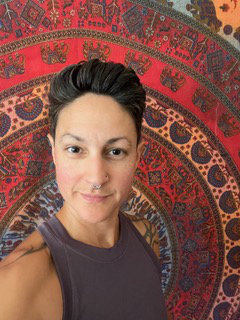
Dr. Nico Conoan Nieves, who humbly refers to themselves as “a jack of all trades and master of none,” is a passionate and inspiring scientist with a multidimensional background. They successfully defended their PhD thesis last May at the University of Oregon (USA), where they focused on single-molecule fluorescence microscopy to study RNA folding dynamics in Dr. Julia Widom’s lab, while running their own business as a licensed residential general contractor, climbing in the mountains, and raising three kids.
At the University of Nebraska Omaha (USA), Nico had the opportunity of working on three different projects during their undergraduate training, ranging from computational biophysics to inorganic materials synthesis for energy storage, and their favorite topic: developing a near-infrared spectroscopy method to quantify methanol contamination in biodiesel. Nico’s post-graduate journey defied the typical academic trajectory by joining the US Army Corps of Engineers in Omaha. After 5 years at the Corps they began to feel unwell and recognized that their high standards for problem-solving, and their experience as a gender minority, might be better aligned with the academic environment: “I decided it was time to pursue what I wanted to pursue directly after college, my PhD”, they explain. In the lab of Dr. Julia Widom Nico didn’t start working on RNA right away but developed a passion for RNA research as soon as they learned about the many facets of RNA behavior and the various ways to study it. “I love studying and utilizing energy transfer. I also love building things. When presented with an opportunity to work in a lab in which I got to build our single-molecule instrument for FRET and other types of microscopy studies, I gladly signed on! Julia has also been a fantastic person to work with and I could not be more grateful to have her as my PI”. Their interest turned to riboswitches, regulatory segments of RNA that bind specific small molecules turning translation or transcription on or off, regulating its own gene expression based on the presence or absence of a ligand. Nico focused their work on class II NAD+ riboswitches, which are bacterial RNAs that bind ligands containing nicotinamide. An RNA Journal paper published by Ron Breaker’s lab became their favorite article as it laid the foundation for their work, describing a novel bacterial RNA motif functioning as an NAD+-sensing riboswitch. Nico is fascinated by the potential of riboswitches as antibiotics that target specific pathogenic bacteria. “One way I see this system functioning is to enhance the ligand-binding of a translational ‘off’ switch to inhibit bacterial colony growth”, they elaborate. Nico believes that “this approach could mitigate some of the challenges that have risen from incidentally eradicating beneficial bacteria from our gut microbiome via our current treatment with antibiotics.”
Nico successfully balanced their PhD with raising three kids, who were in high school and middle school when they started graduate school, and launching a small business as a licensed residential general contractor. They admit that their greatest challenge was “simply accomplishing all the things there are to accomplish!”. A key to navigating this demanding period was accepting that “I cannot do all the things”. Over the six years of their PhD, they learned to embrace their limitations and to recognize which things to focus on and which to let go. Nico also reflects on the difficulty of transitioning from doing everything independently to collaborating effectively with colleagues. Yet they rose to the challenge: “In just over two months, a colleague and I had redesigned and rebuilt the fluorescence path of our single-molecule instrument, collected and analyzed 18 different sets of data from the instrument”.
“The times I spent trying to fit into someone else’s mold were the most challenging times of my life. I have found that when I pursue my desires and live by my own standards, opportunities in support of my direction simply start opening up in front of me.”
As someone who “takes action when systems need fixing”, Nico has served as Treasurer in their graduate student labor union and for the Community for Minorities in STEM (CMiS), an organization whose values they are deeply committed to growing: “I want to see more people of color engage in science and one way to encourage this is to build community. That’s exactly what CMiS is about”. They are a strong believer that minorities “need people who are accepting, willing and capable of advocating for and supporting us as mentors or advisors. People have to feel heard in order to want to speak up”. Reflecting on their personal journey, Nico shares: “The times I spent trying to fit into someone else’s mold were the most challenging times of my life. I have found that when I pursue my desires and live by my own standards, opportunities in support of my direction simply start opening up in front of me”. And their advice for young RNA scientists is to find a healthy environment and a topic that aligns with their strengths.
Nico actively participated in two RNA Society meetings, first as a speaker in Boulder, in 2022, and then with a poster in Singapore, in 2023. For them, the RNA Society represents a welcoming and supportive community that has encouraged their continued work in RNA research. While they are broadly inspired by RNA, they are particularly fascinated by RNA viruses, as they are simple but can have a huge impact on other species. “It makes me wonder whether we can hijack/exploit this machinery to benefit humans or other beings instead of just making us unwell”, they ponder.
And if you think that is the whole story, wait until you hear about their current plan: Nico recently moved into a cabin in the forest for a one-year respite! They love climbing in the mountains and spending time among the trees: “Being in the forest is so good for my mental health! It is where I can breathe clean air and be far from the commotion of even the smallest of cities. After spending some time in the woods, I am more calm and I think more clearly. Both of these are conducive to solving technical problems or analyzing biophysical data”. After their year in the forest, Nico plans to seek out contracts to build single-molecule instruments in academia and/or industry. You can reach out to them via LinkedIn or directly by email.