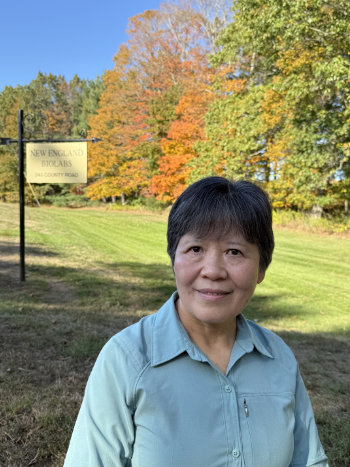
If you have been doing RNA research and have used any RNA-focused products in the Ambion or New England Biolabs® (NEB®) catalogs, then it’s almost certain that you’ve used one of the many products that Dr. Dongxian Yue helped develop and bring to market for the RNA community. She’s currently one of NEB’s Principal Production Scientists and has helped to shepherd new RNA-focused products into customer’s hands – this can include identifying a need, assisting in development and production, and providing technical support. When you consider the impact that her work has had on how we do RNA biology research, her story is even more remarkable.
Dr. Yue came from very humble beginnings and was raised in a small farming village in central China (Henan Province). Despite only having gone to school for 9 years, she was admitted to the East China University of Science and Technology in Shanghai from which she graduated with a BS in Biochemistry in 1984. After graduation, she spent 6 years working in a joint venture company with Sino-American Biotechnology Company in Luoyang, China partnered with Promega based in Madison, Wisconsin USA. This early exposure to the biotech industry shaped her entire career.
While working for Promega’s China Branch she spent 6 months at Promega headquarters in Madison in 1987-1988. During that time, her supervisor Dr. Tom Van Oosbree told her that “you are qualified for graduate school in US”. She returned to China in 1988 to set up an enzyme production facility. Then, when Tom visited the facility in 1989, he again encouraged her to apply for graduate school and he gave her $30 for the application fee. At that moment she decided to try it. She re-doubled her efforts to learn English and applied. She sent a hand-written application to Iowa State University in the spring of 1990. To her surprise, she was accepted into their graduate program with a full scholarship. “Tom believed in me more than I did. I am deeply grateful for that. We have been life-long friends.” Notably, Madison remains a special place for her personally and professionally.
She graduated with her PhD in Biochemistry in 1994 after studying the roles of base modifications on tRNA structure and function by NMR and aminoacyl-tRNA synthetase charging kinetics with Jack Horowitz at Iowa State University. Her mentor often told her “you are going to be a first-class scientist. You need to learn how to think.” During her dissertation work, she generated hundreds of milligrams of fully active tRNA both by in vitro transcription (IVT) and by isolation from E. coli. She remains amazed by all the modified bases in tRNA. This experience not only filled up a lot of space in the lab freezer, it also opened her eyes to the RNA world.
In her mind, the most impressive and her favorite RNA Society meeting to attend was in Prague 2017. She was in the audience that gave a long-standing ovation to Dr. Adrian Krainer when he presented the highly successful antisense RNA (Spinraza) therapy for spinal muscular atrophy. Having first met Dr. Krainer decades earlier at Cold Spring Harbor Laboratories in 1994, she was thrilled with his achievement. That being said, she has a long history of attending RNA Society meetings. As a postdoc in Alan Weiner’s lab at Yale University, she presented her research on the CCA-adding enzyme (tRNA ‘finisher’ enzyme) at the first ever RNA Society meeting in Madison in 1996. She vividly remembers being part of a discussion where Alan Weiner and her PhD mentor Jack Horowitz brainstormed the mechanism by which the CCA adding enzyme worked. All tRNAs have a 3’ CCA end. However, many of the CCA ends are not encoded in the DNA genome and the 3’ CCA is added post transcriptionally by the enzyme. The key question was how the enzyme can add CCA specifically with a defined sequence, length and without using a DNA or RNA template. Her first paper on CCA-adding enzyme was published in RNA in 1996.
In the Fall of 1998, she joined Ambion (founded by Matt Winkler) in Austin, Texas since they focused on RNA biology and it was a perfect fit for her skillset and training. When she joined, she was their only PhD-level scientist in manufacturing. Notably, the team and culture of innovation that Winkler assembled was ahead of its time. He predominantly pulled talent from other industries. For example, they had engineers with experience from NASA (who really had worked on rockets!) that trained Ambion scientists how to develop robust products and workflows. This cross-industry experience allowed Ambion to have a very different design process than other biotech companies. She was inspired by product development engineers that she met early on in her career at Ambion. They really worked to streamline their processes in advance before they released them. As an RNA pioneer, Ambion grew rapidly from ~80 people in 1998 eventually reaching ~300 people in their RNA division alone in 2005.
She spent an amazingly productive 9 years at Ambion. Dr. Yue was responsible for establishing the company’s enzyme production capabilities and optimized the MEGAscript IVT product line. She also worked on key enzymes for mRNA amplification workflows including reverse transcriptases, RNase inhibitors, and T4 DNA Polymerase to support Ambion’s MesssageAmp product line. The system amplifies mRNA linearly by first converting mRNA into double stranded cDNA and then in vitro transcribes the cDNA into labelled RNA for Gene Chip analysis. She also developed a bacterial based in vitro translation system (ActivePro) which is still considered best in class. The system can produce highly active proteins with high yield and full length (with the 120KD Beta-Gal protein being a great example). One of her highlights at Ambion was presenting at their quarterly scientific advisors meeting. Ever humble, Dr. Yue states “I learned so much from those giants.” The bottom line: Dr. Yue truly played a major role at Ambion, living up to its motto as “The RNA Company”.
In 2007 NEB was looking to expand their RNA product portfolio in Ipswich, MA. Since NEB had been a research cornerstone since the 1970s, Dr. Yue knew that NEB would provide her with an unparalleled platform to apply her skills and knowledge from her past industry and academic experience to make innovative products for the research community. Importantly, she also had family reasons for returning to the northeast where she had done her postdoctoral work. Simply, her husband’s family lived in the northeast, and she wanted her daughter to grow up closer to her cousins and other relatives. She considers her decision to move to Boston and join NEB as one of the best ones that she has made for both her career and family. In this regard, Dr. Yue serves as a great reminder to the RNA community that one will never be truly satisfied by work until they are happy in life in general.
“Industry positions are always looking for a ‘fit’. How could you fit in with the setting and with the team? How will your skills benefit the company? What will you expect from the company? Are you curious? RNA biology continues to be exciting and challenging. Keeping a life-long learning mindset is necessary. For any lab position in industry having good hands, being organized, and being motivated to return results are all highly desired traits.”
Dr. Yue knew exactly what her job would be when she joined NEB … to grow its RNA portfolio. To do so, she started at the very beginning. As we all know, RNA can be extremely fragile. Therefore, the enzymes and reagents in contact with RNA must be extremely clean and free from RNases. The very first thing she did at NEB was to establish an E. coli host strain that would optimize expression of highly-pure, RNA-related recombinant proteins. Also, since trace amounts of RNases are everywhere, RNase inhibitor is essential for RNA protection. Since Promega still owned the human RNase inhibitor patent in 2007, she collaborated with scientists at NEB to develop and launch Murine RNase Inhibitor which has grown into a key reagent for RNA scientists. As the final part of her ‘opening act’ at NEB, since all RNA reagents must be of high quality, she designed a sensitive RNase assay to qualify enzymes for use in RNA workflows. . Dr. Yue clearly embraced the fact that a strong foundation is key not just for laboratory buildings, but also for the experiments and assays that take place inside of them.
With these measures and products in place as a foundation for RNA science, NEB continued to develop an impressive array of RNA products. Dongxian’s experience with in vitro translation was valuable during the development of the PURExpress® system – an entirely reconstituted system based on E. coli which was released in 2009. The system combines ~40 purified proteins (Aminoacyl tRNA synthetases, transcription enzymes, translation initiation, elongation, and release factors plus energy generating factors) and purified active ribosomes. The most challenging part was purifying enough ribosomes. She designed and streamlined an efficient manufacturing workflow to produce active ribosomes at scale. Notably, she even developed specialized versions of the kit (minus ribosome, minus release factors, etc.) for different research questions. Versatility, after all, is often a kit’s most valuable asset.
While developing and managing the PURExpress product line, she was also working on improvements to NEB’s HiScribe® in vitro transcription product line, which was released in 2011. Once again, she started at the very beginning by reworking and customizing NEB’s T7 and SP6 RNA polymerases. Aside from being user-friendly, one of HiScribe’s key advantages was to allow for both high rNTP input and maximum RNA yield. She continued to adapt the HiScribe line to include kits intended for early line RNA therapeutics research including those that generate ARCA and CleanCap-based capped mRNAs – and even sgRNA. As if that wasn’t enough, Dr. Yue also contributed to the expansion of NEB’s RNA tools including Vaccinia Capping Enzyme, 2’O Methyltransferase, Pyrophosphatase, E. coli RNA Polymerase core and holoenzyme, plus NEB’s RNA ladders (high and low range plus dsRNA). The dsRNA ladder has been popular in recent years as a control for dsRNA detection. She also developed a custom RNA ladder used by a major RNA analysis platform. Talk about climbing the ‘ladder’ of success, eh?
Her advice to scientists thinking about an industry career is that “industry positions are always looking for a ‘fit’. How could you fit in with the setting and with the team? How will your skills benefit the company? What will you expect from the company? Are you curious? RNA biology continues to be exciting and challenging. Keeping a life-long learning mindset is necessary. For any lab position in industry having good hands, being organized, and being motivated to return results are all highly desired traits.”
Developing a successful product requires an understanding of what the marketplace needs and how the product will be used. It is helpful to anticipate where the field is headed, but also imagining possible ‘off-label’ uses. Dongxian and the team at NEB focus on making the protocols as simple as possible so researchers can be successful the first time they use the product. This helps design ‘robust’ products that can sometimes buffer for the inevitable user errors that happen in the lab. Another equally important part is customer support. She has personally been answering tech questions for the past 10+ years alongside the tech core at NEB. Yes, if you’ve asked NEB for RNA support, you’ve likely already worked with Dr. Yue! She gets great satisfaction from helping scientists use the tools she helped to develop.
Though working in a production setting, Dr. Yue has closely followed major breakthroughs in RNA research and industry. Having witnessed major discoveries in RNA biology from RNA splicing, ribozyme, antisense, siRNA, miRNA, CRISPR to mRNA vaccines, she feels lucky to be an RNA person. She has closely followed the mRNA therapy field and in 2013, she was one of the ~150 people at the first mRNA Health Conference in Tübingen, Germany. She continues to attend mRNA Health and other conferences regularly.
By 2015 NEB made the decision to build an ultra-high quality manufacturing facility in Rowley, MA (~15 min from NEB’s headquarters in Ipswich). Products manufactured at NEB’s Rowley facility are manufactured in compliance with ISO 9001 and ISO 13485 quality management system standards and supports customers in need of NEB’s highest quality grade products and documentation for further processing. Transferring NEB’s IVT enzymes, reagents and protocols to that facility was a slow and painstaking process. During the summer of 2019, the facility was completely validated and had produced multiple production lots. By 2020 when COVID-19 pandemic began, NEB’s RNA product line was in place and ready to deliver. In fact, NEB’s IVT reagents have been supporting the manufacturing of a major mRNA vaccine.
Her favorite RNA is “Beautiful tRNA -no doubt!” This goes back to her early training and its key roles in translation and beyond. Although tRNAs were formally discovered decades ago, work on this class of small RNAs still continues and we keep learning more and more about the vital roles that tRNA plays. When it comes to her favorite RNA paper, Dr. Yue states: “As an application-oriented RNA scientist I am interested in reliable methods. I like this 2020 article “Live-cell imaging of single mRNA dynamics using split superfolder green fluorescent proteins with minimal background” by Sung Young Park, et al. In this paper the authors built a system that images single mRNA clearly in real time by splitting superfolder GFP into two or three nonfluorescent parts that reassemble into active GFP only when bound to target mRNA. Several biological mechanisms were applied, MS2 phage biology, PP7 phage biology and the superfolder GFP biochemistry. The system solved a major problem of high background associated with earlier approaches. This powerful tool has been useful in RNA spatial biology.”
Dr. Yue doesn’t have a presence on social media, but you can reach her via email: [email protected]