
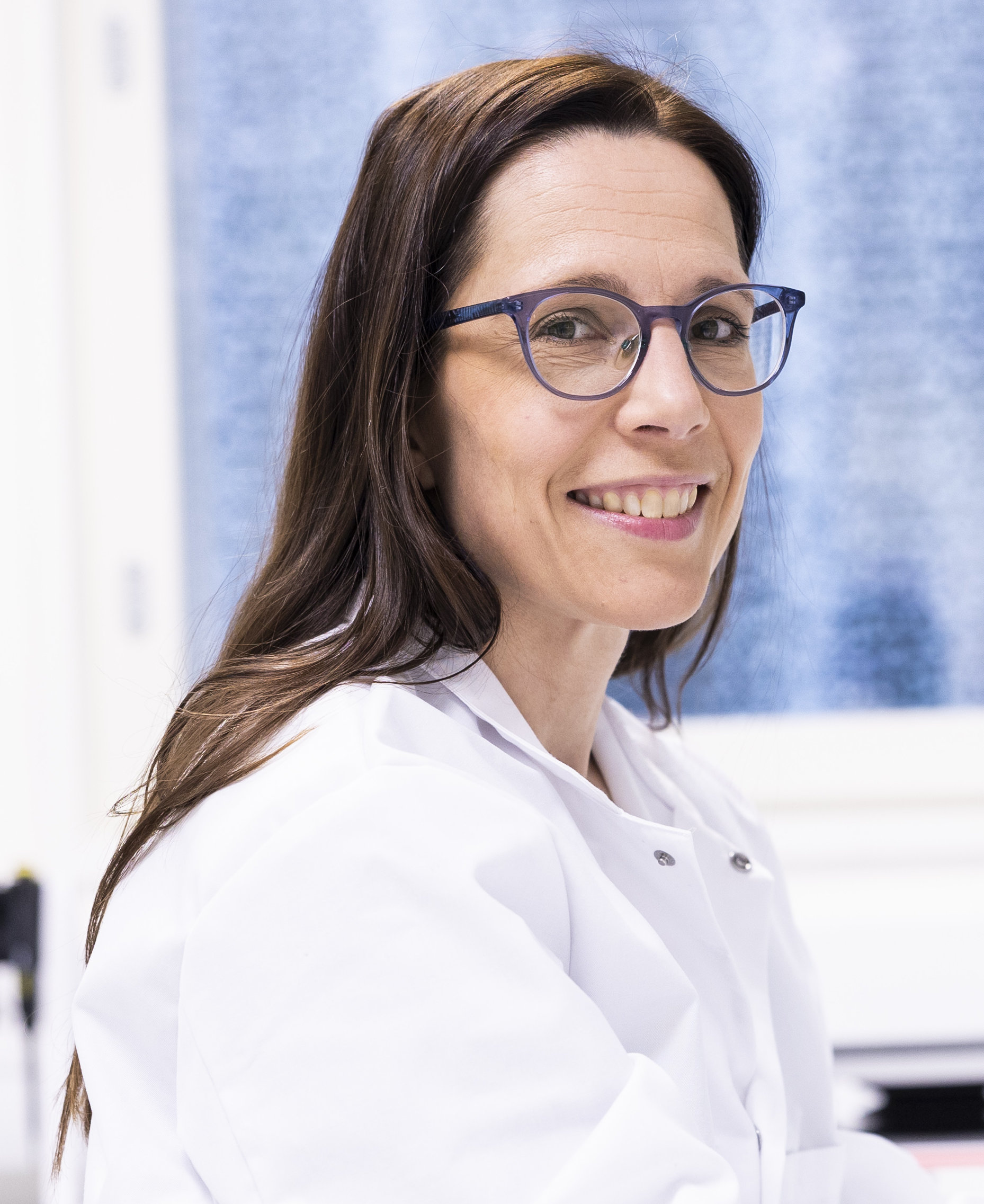
We are delighted to put the spotlight on Prof. Minna-Liisa (Minni) Änkö, the current coordinator of one of the RNA Society’s most cherished and long-running initiatives, the RNA Salon Program, which celebrates its tenth anniversary this year. Minni was recently appointed Professor of Cell Biology at Åbo Akademi University in Turku, Finland, after four years as head of the Functional RNAomics laboratory and Associate Professor in Molecular Biology at Tampere University. Minni has been an active member of the RNA scientific community for two decades, studying splicing and becoming one of the foremost experts on the biology of serine/arginine-rich (SR) proteins, multifunctional regulators of RNA processing found in all major eukaryotic lineages. It was a PhD in neuroscience that set her on this path: “I bumped into alternative splicing when we were trying to clone neuropeptide receptors involved in pain regulation,” she recalls. “I became absolutely fascinated by RNA processing. My partner is a scientist, and we attended the Society for Neuroscience conference towards the end of our PhDs. We met a senior group leader from the Max Planck Institute for Cell Biology and Genetics (MPI-CBG) who invited us to visit the institute in Dresden, Germany. It turned out that Karla Neugebauer had moved to Dresden quite recently (and worked on splicing). I interviewed in Karla’s lab and eventually joined MPI-CBG.”
For Minni, these were formative years. “It was a great place to do a postdoc with fantastic facilities and a lot of freedom in my research. It was also an exciting time in Karla’s lab because the first papers on co-transcriptional splicing were just coming out.” She credits mentors whose guidance has shaped her career, including Karla and Kai Simmons, a founding director at the MPI-CBG. “Both Karla and Kai were able to think outside the box and they demonstrated the importance of finding your research niche.” Taking that lesson to heart, Minni set out to carve her own path as she started her independent career, moving even further away from her native Finland. “For scientist couples, each career move is a challenge and the farther you get in the career path the harder it gets. We ended up getting job offers in different places, but Melbourne in Australia was the option that somehow worked for both of us.” The transition wasn’t easy. “To be honest, the first couple of years in Melbourne were very difficult for me, but it worked out in the end. I established my lab at Monash University, then moved to the Hudson Institute of Medical Research. I was very happy there.“ Contributing to the complexity of this period were significant personal challenges. “I had some major health issues soon after I started my laboratory, I could barely walk while I also had a small child.”, Minni confides. “Only afterwards have I realised how much this affected my research capacity during the critical early years of my career. I think my perseverance and unwillingness to give up brought me back to my feet both physically and scientifically. I wanted to do the things I love, science and exercise.”
“Study whatever interests you the most. Motivation and passion are integral parts of success and will carry you a long way.”
After nearly twenty years abroad, Minni returned to Finland in 2022. “The main attraction was the possibility to be closer to the European science scene and, well, most other places than Australia.”, she explains with a smile. “Australia is wonderful, but far away! I have now been able to attend more meetings and accept invitations to speak because travel times are much shorter.” At this point, Minni was ready for new challenges. “Thinking back, I probably also needed the change. Moving the lab was a pain but also an opportunity to renew and refocus our research.” Having secured major funding after her move to Tampere, Minni rapidly expanded her group and launched exciting new projects. “Recently, we have adapted and developed long-read sequencing methods in the lab, and I find the possibility to study RNA processing and RNA-binding protein activity in the context of the full-length transcript very exciting.”, she says. “We are about to send some of this work out to the world soon – part of it is already available on bioRxiv. I am looking forward to expanding this area of research in my lab. Overall, the rapid development of methods to address questions that just a short while ago were technically not possible is fascinating in the field of RNA biology.”
The value of scientific networks is something that Minni discovered early, during her postdoc years in Dresden, where participation in EURASNET, the Alternative Splicing Network of Excellence funded by the European Union, of which Karla’s lab was a member, allowed her join in activities across Europe and meet many excellent RNA scientists. Eager to foster similar connections in Australia, she teamed up with colleagues at Monash University to initiate Australia’s first RNA Salon, meRNA, in 2016, creating a space to connect with like-minded people and discuss all kinds of RNAs. Now back in Finland, she co-organizes fiRNA, the RNA Salon Finland, together with Mikko Frilander.
Since 2023, Minni has served as coordinator of the RNA Society’s RNA Salon program, a role through which she proudly supports “a wonderful initiative that has a major impact on the local RNA communities world-wide.” Launched in 2016, the RNA Salon program provides financial support for recurring, locally organized events centred on RNA science. “The aim is to promote engagement and interaction among RNA scientists and advance the training and professional development of RNA researchers. I hope they can provide a sense of belonging to RNA researchers.”, Minni explains. The program has grown remarkably: There are now 65 RNA Salons on all continents (except Antarctica), which reach over 7,000 researchers. Salons can also be featured on the RNA Society website to increase their visibility (more information can be found here: https://www.rnasociety.org/salons). In her current position, Minni views herself as an ambassador of RNA science: “I have been involved in many early-career researcher mentoring programs and also give talks in schools and at other public events about RNA research. RNA is still an emerging field in Finland, but I try to spread the word.”
What advice does Minni have for the next generation of scientists? “Do what you love!”, she encourages. “Currently, students seem to be very worried about their future. Undergrad students frequently ask me what subjects they should study to make it, or how to become a researcher. I always tell them to study whatever interests them the most. Motivation and passion are such integral parts of success and will carry you a long way.”
Minni has attended many RNA Society meetings over the years, and, when pressed to name a favorite, finds herself returning to the one in Kyoto. “After an intense week of science, we rented bikes with some RNA colleagues and rode along the river – we had a wonderful afternoon,” she recalls. “Just as much as I look forward to the science, I enjoy catching up with RNA friends at the annual meetings”. For fellow RNA processing enthusiasts, she recommends reading “Connecting genotype and phenotype in minor spliceosome diseases”, recently published in RNA Journal. “It’s an insightful perspective by my Finnish RNA colleagues, and a great read”.
You can follow Minni’s updates on @rnaminni.bsky.social, or check out her lab webpage https://research.tuni.fi/functional-rnaomics/.