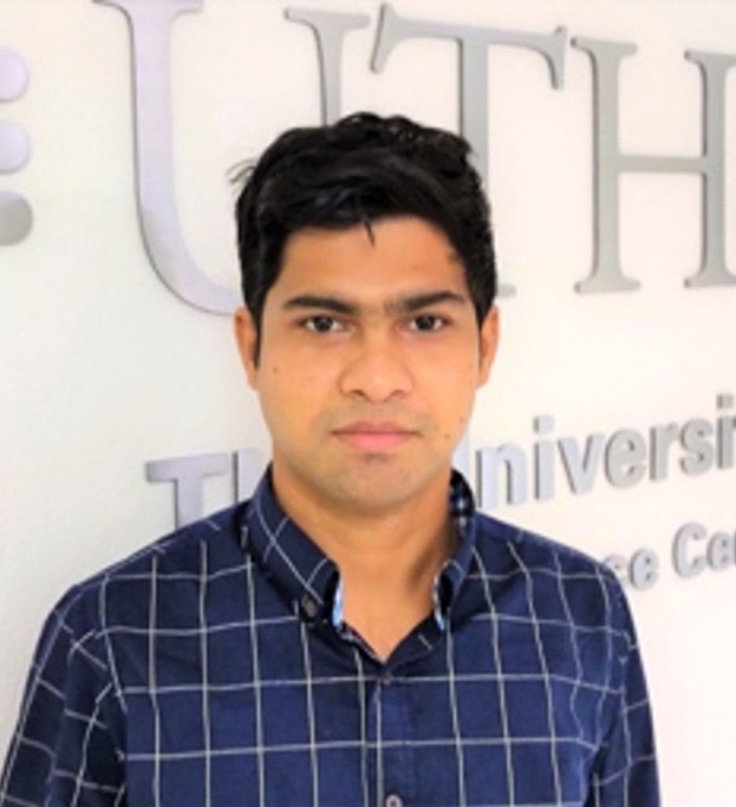
Khondakar Sayef Ahammed is a Postdoctoral Fellow in the Department of Molecular Genetics at The Ohio State University, USA, under the supervision of Prof. Ambro van Hoof. Sayef completed his doctoral studies at The University of Texas MD Anderson Cancer Center, UTHealth Graduate School of Biomedical Sciences in Houston, Texas, USA, where he investigated the functions of enzymes involved in eukaryotic RNA processing and degradation pathways, including the RNA exosome complex and tRNA splicing ligase.
Sayef was born and raised in a small village in India. He recalls that about 15 years ago, there was limited access to modern equipment at the college where he pursued his undergraduate degree. An important step in his career was his Master’s studies in Microbiology at St. Xavier’s College in Kolkata, which sparked his interest in academic research.
After completing his master’s degree, he realized he needed more laboratory experience before starting his PhD. He then worked as a Research Assistant under Dr. Sanjay Dutta at the Indian Institute of Chemical Biology in Kolkata, India. In Dr. Dutta’s lab, he studied how small-molecule compounds interact with nucleic acids to change the tertiary structure of DNA and RNA. Later, he moved to the University of Texas Health Science Center at Houston, Texas, to pursue his doctoral studies. Sayef’s journey into the “RNA world” began during his graduate training in the van Hoof Laboratory, where he researched the function of the RNA exosome complex and tRNA splicing ligase in budding yeast.
“The joy of doing experiments is that they keep the curious mind alive. Let the excitement guide the path to discovering new things. All the miseries and failures come with the package, and in the long run, they hardly matter.”
Several conserved RNases and RNA ligases play crucial roles in shaping the RNA processing and decay events and regulating the overall gene expression program of the cell. Importantly, mutations in conserved RNases, including subunits of the RNA exosome complex (the major eukaryotic 3′–5′ exoribonuclease), are linked to a range of inherited genetic disorders collectively known as “exosomopathies.” In collaboration between the van Hoof Laboratory and the Anita Corbett Laboratory at Emory University, he helped develop genetic tools to identify pathogenic human variants that cause RNA exosome–associated diseases, using Saccharomyces cerevisiae as a model system. Sayef investigated the molecular mechanisms by which mutations in EXOSC1/Csl4, a subunit of the core RNA exosome complex, cause defects in RNA processing and degradation in the cell. He mentioned ‘The beauty of using budding yeast as a model to analyze patient mutations is that we can access simple and well-developed genetic strategies to gain insights into complex diseases that are otherwise difficult. Additionally, we can use patient mutations to identify previously unknown functions of the molecular machines, in my case, the RNA exosome.’
In parallel, Sayef is developing fungal tRNA ligase (Trl1) as a promising antifungal drug target. Fungal infections are among the emerging public health threats worldwide, and we have very limited treatment options in the clinic. As human and fungal tRNA splicing ligases are biochemically and structurally distinct, there is a substantial opportunity to target Trl1 for antifungal drug development. In a recent study, Sayef demonstrated that most human pathogenic fungi species encode functional Trl1 orthologs that could serve as broad-spectrum antifungal targets. A surprising finding from this study identified that early-diverging fungi in the order Mucorales contain an atypical Trl1, highlighting an exception to the composition of the highly conserved tRNA processing machinery in fungi. He added, ‘It is very important to learn how Trl1 functions across evolutionarily diverged fungal pathogens to pre-determine the potential challenges for drug development.’ His current work in the van Hoof Lab focuses on the functional characterization of the fungal tRNA ligase (Trl1) to develop new therapeutic targets against human pathogenic fungi.
Looking back, several great mentors have helped shape his academic and research journey. Perhaps my greatest scientific inspiration is my PhD advisor, Ambro van Hoof, and the advisory committee members in the graduate school, who closely guided me in constantly improving my thought process and nurtured me throughout my research career.
Sayef had the opportunity to attend the RNA Society Meeting in Boulder and Edinburgh. The RNA society meetings have been encouraging for me. In addition to learning great science from around the globe, I met some of my scientific heroes at both meetings, whose work laid the foundation for my current research projects on tRNA ligase and the RNA exosome. The most fun experience was hanging out with friends and poster hopping.
Sayef’s favorite RNA is broadly non-coding, including tRNA. He contemplates, “It is interesting to see how recent discoveries of many small and long non-coding RNA species are rapidly changing our view of gene regulation program of the cell and how these RNAs contribute to disease and development. Many untold stories are hidden behind these noncoding RNAs in the cell, and there is much to know about their life cycle and functions in the cell”.
Sayef’s favorite RNA journal articles included Cherry et al.’s 2018 RNA article from Jay Hesselberth’s lab, which identified a clever strategy for bypassing Trl1 function by expressing intron-less tRNAs in yeast. This is a classic example of how the need for an essential cellular enzyme (Trl1) can be bypassed by artificially expressing the end-product (mature tRNA) of the pathway. Another paper he mentioned is an often cited informative review article titled “The life and times of a tRNA” on the biology of tRNAs by Professor Phizicky and Professor Hopper.
He also highlighted a recent article published in the RNA Society’s Journal RNA, identified the first known eukaryote, Levipalatum texanum, that lacks introns in any tRNA genes. This paper identifies the first exception to nature’s rule where all eukaryotes known until this one contain a certain number of tRNA genes with introns.
When asked for one piece of advice for the next generation of RNA researchers, he said he learned from his mentors that enormous curiosity and persistence are the most fundamental qualities that can make a difference. There might be a thousand different ways to solve a core problem, but let’s be curious about finding another new and unexplored one. Persistence will take care of your big dreams in the long run.
You can follow Sayef on LinkedIn at www.linkedin.com/in/khondakar-sayef-ahammed-2ba018274.