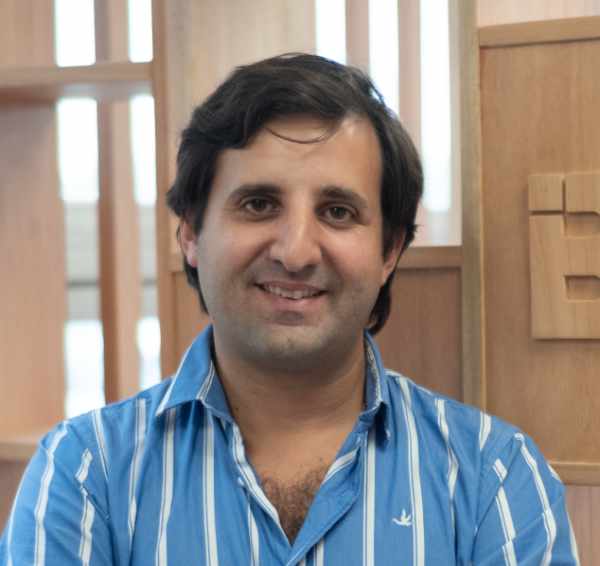
One of Dr. Juan Pablo Tosar’s proudest moments came from social media, when he replied to the RNA Society’s question of whether we should have an RNA day with “AUG1”, thereby contributing to the initiation of a beloved holiday for the RNA community. Dr. Tosar is an Assistant Professor at the Universidad de la República (UDELAR) and a Principal Investigator at the Institut Pasteur de Montevideo (Uruguay), where he works to understand how extracellular RNAs act as signaling molecules to elicit immune responses. Following an interest in cancer biology after his mother’s diagnosis with breast cancer, Dr. Tosar completed his PhD at UDELAR under the mentorship of Dr. Alfonso Cayota, where he was first introduced to the world of RNA. He recalls, “I was lucky enough that Alfonso Cayota accepted me as a graduate student in his lab, which I chose because they were working on cancer. I had no idea they were mostly an RNA biology lab and I fell in love with RNA as soon as I started working there.” Shortly after defending his PhD, Dr. Tosar took up his current position as an Assistant Professor and has been studying the world of extracellular RNAs ever since. Since becoming a professor, he reflects, “I don’t miss pipetting, though I am sometimes nostalgic about the feeling of placing a gel in the transilluminator and finding an unexpected result that could potentially mean something new. I tell my students not to tell me immediately when that happens to them: ‘savor it first; share a secret with the universe for a while’.”
Although he has spent his entire career working in Uruguay, “a small country in South America, better known for soccer than for science,” Dr. Tosar also had the opportunity to spend several months doing science abroad, which emphasized the importance of collaboration in furthering one’s science. “Science cannot be done in isolation,” he shares. “You need to talk with people and share their workspace for a while. We can talk over zoom and agree on specific tasks, but you don’t build a relationship of trust, nor can you ‘reason in resonance’ with scientific peers if not connecting in person.” Dr. Tosar credits a one-month internship with Dr. Kenneth Witwer at the Johns Hopkins School of Medicine (Baltimore, USA) during his PhD for shaping his subsequent research and career path. “I was a young graduate student from a remote place asking to do some experiments with him. He could have simply ignored my email, but he did not. Today, Ken is undoubtedly our most solid and stable collaborator. We have grown over the years a relationship of trust and mutual scientific respect. Had my email gone into his spam folder, I don’t think I would be in the same place right now. People who help you when you are still young and don’t have much to give in exchange: those people are heroes and make Academia a brighter place.”
“Reflect on your inner purpose, prioritize teamwork, and have fun. Don’t let external factors or other people extinguish the joy of uncovering the universe’s hidden mysteries.”
In embracing a global and collaborative approach to his science, Dr. Tosar has found inspiration from many fellow scientists. Dr. Carlos Rovira, a Uruguayan molecular biologist who worked in Sweden until he passed away a few years ago, influenced Dr. Tosar’s mindset towards tackling big picture questions. “Carlos was extremely passionate about science in general, and about small RNAs in particular,” he says. “His words pushed me beyond the limits of my research project and forced me to ask myself broader, more provocative questions and then to go to the bench and find ways to answer them. A problem we usually face in Uruguay is the idea that, because it’s such a small country with limited resources, the big and important questions are beyond our reach. Carlos challenged me and forced me to abandon this trap of the mind.” Still, Dr. Tosar acknowledges the difficulty of doing science in a country where all reagents need to be imported, often taking several months to arrive and at a higher cost. This necessitates a stricter approach to experimental design, because “there will be months between the moment an experiment is conceived and the moment it can be executed. Therefore, you can’t afford a badly designed experiment or you will lose too much time. We really need to put a lot of thinking into everything we do and test.” Similarly, he shares his respect for the resilience of the Argentinian RNA community. “They are still working in the lab, trying to do the best possible science they can. But their grants have been cut, or reduced to the ground, and they have literally no money to work with. They have been punched right in their face, unfairly, but they are not renouncing their passion. They have purpose. They will succeed.”
“I am sometimes nostalgic about the feeling of placing a gel in the transilluminator and finding an unexpected result that could potentially mean something new. I tell my students not to tell me immediately when that happens to them: ‘savor it first; share a secret with the universe for a while’.”
In addition to leading a lab at two different academic institutions, teaching undergraduate and graduate courses, and founding the biotech company B4-RNA Diagnostics, Dr. Tosar is also involved in his local RNA community through the Uruguayan RNA Club, which he co-founded with support from the RNA Society’s RNA Salon program. “This support has enabled us to strengthen bonds with other labs studying different aspects of RNA and to make a small but vibrant community of RNA researchers in Uruguay.” He hopes this will also showcase the exciting science done by Uruguayan scientists such as Dr. Adrian Krainer. Dr. Tosar recalls listening to Dr. Krainer’s lecture at the 2017 RNA Society meeting in Prague, which ended with a well-deserved standing ovation. “That ovation was not only because of the success story of Spinraza, but mostly because it showed Adrian’s decades-long personal journey from basic research on alternative splicing to a new cure for a devastating disease. Prof. Krainer was born and lived in Uruguay until he moved to the US for college. And I realized I didn’t hear much of his work at home, despite his story being truly inspiring. Kids and teenagers in Uruguay know everything about the life of Uruguayan soccer players and this makes them dream of becoming soccer players in the future. Why is it so different when it comes to scientists?” Dr. Tosar aims to highlight RNA science and its heroes in Uruguay, which he hopes will encourage young people to consider a career in science.
Dr. Tosar’s favorite RNA is “tRNA, for sure. They are in the center of the genetic code. The stability of tRNAs is something that really amazes me and we are studying what happens to these molecules once they are released from cells into the extracellular space.” He also has a keen interest in using RNA to reveal the past, inspired by his favorite paper in the RNA Journal about “paleotranscriptomics”. You can learn more about him and his work on BlueSky, X, and LinkedIn @jptosar or at a future RNA Society meeting.