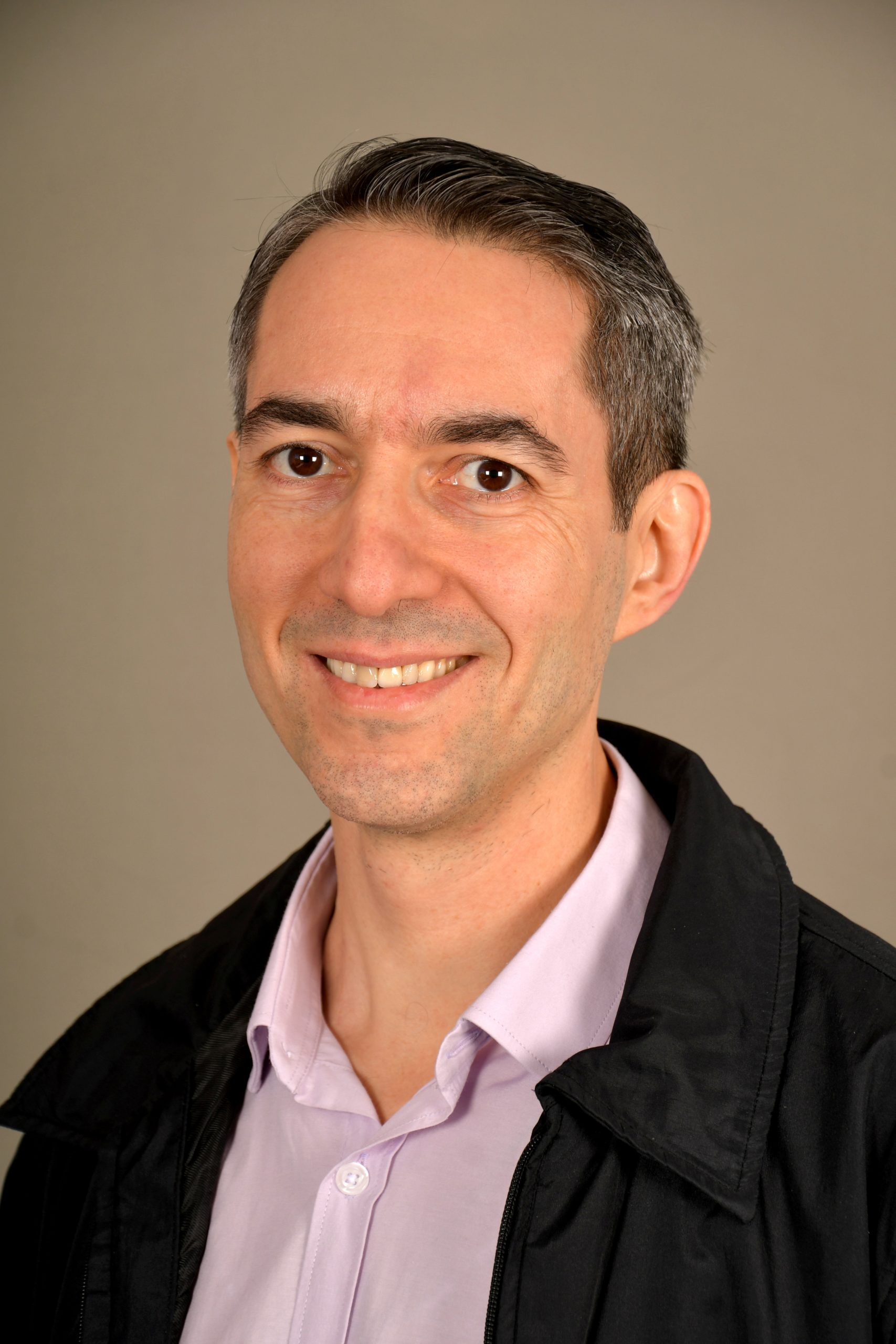
Dr. Alexandre Rossi Paschoal is an example of multicultural and international scientific career distinguished by his ability to foster collaborative and interdisciplinary environments. He serves as an Associate Professor in the Department of Computer Science at the Universidade Tecnológica Federal do Paraná (UTFPR) in Curitiba, Brazil, and held the position of Group Leader in Artificial Intelligence (AI) and Informatics at the Rosalind Franklin Institute in Oxford, UK, for nearly three years (2023-2026). These dual roles highlight his versatility and his contributions to shape a truly worldwide scientific community. As a bioinformatician, he has built transformative computational methods, tools, and databases to support data-driven decision-making in the life sciences and is currently focused on non-coding (nc) RNAs. He strongly believes that AI will revolutionize our understanding of RNA biology by decoding the hidden functions of ncRNAs.
Alexandre began his journey in Computer Science in Brazil, where he learned “to see data as patterns”. He pursued a PhD in Bioinformatics at the University of São Paulo, which introduced him to RNA research. During this time, he explored regulatory RNAs hidden within ‘junk DNA’, focusing on RNomics as databases to investigate ncRNAs in insects and cancer. He applied AI-driven bioinformatics approaches to identify ncRNAs, including microRNAs, mirtrons, and long ncRNAs. Mirtrons are microRNAs derived from spliced-out introns of mRNAs and are known to regulate gene expression. These molecules became Alexandre’s favorite RNAs, as “they are unexpected, unconventional, and challenge the idea of canonical pathways. They embody creativity in RNA biology”. During his early training, Alexandre was inspired by several figures. From his Master’s advisor, Dr. Claudia Barros Monteiro-Vitorello and his PhD advisor Dr. Alan Mitchell Durham, he learned the value of scientific rigor and the importance of an interdisciplinary vision, qualities he considers essential in bioinformatics: “without this perspective, we risk building useful computational tools whose outcomes are disconnected from biological reality”. Moreover, Nobel Prize Barbara McClintock’s career is for Alexandre “a powerful reminder of the resilience and perseverance required in science and life”. A key moment in Alexandre’s training was organizing the 2008 EMBO Practical Course on RNA Computational Biology as a PhD student. This opportunity, offered by Professors Robert Giegerich and Kay Nieselt, to whom he remains deeply grateful, had a significant impact on his career. “The EMBO course put me in contact with some of the main brains in RNA biology and the computational/bioinformatics side”, Alexandre explains.
Later, as a DAAD (Deutscher Akademischer Austauschdienst, or German Academic Exchange Service) postdoctoral fellow at the University of Leipzig, Germany, Alexandre worked on computational methods in ncRNAs in plants in the laboratory of Dr. Peter F. Stadler. These contrasting cultural and scientific environments proved crucial to his career: “Brazil shaped my creativity, resilience, and interdisciplinary skills—working with limited resources taught me to innovate. Germany taught me to be more precise (methodical)”.
“RNA biology teaches us humility: what was once labeled ‘noise’ often becomes essential.”
After serving as an Associate Professor in Brazil since 2010, Alexandre was ready to take on a new career challenge when he joined the Rosalind Franklin Institute in 2023. He maintained his advisory role in Brazil and established the Biological Data Science Lab, motivated by the potential for strong collaboration, and the powerful computational resources available in the UK. In his words, ”the Institute’s uniquely interdisciplinary environment—bringing together biologists, chemists, engineers, and computer scientists—offered the ideal setting to apply AI-driven bioinformatics to RNA biology”. His intercontinental positions as a group leader in the UK and advisor in Brazil represent a challenge that Alexandre embraces thanks to his driven personality and extensive experience. “Balancing research in the UK with mentorship in Brazil has been both demanding and enriching, enabling me to share cutting-edge methods with students while fostering vibrant cross-continental collaborations”.
Alexandre devotes a significant part of his career to mentoring students and fostering young scientists. His students’ awards, such as best poster in conference or thesis defense, are among his greatest sources of pride. This commitment is reflected in the greatest challenge he faced in his career when becoming coordinator of the UTFPR Master’s Program. “The greatest challenge I faced came in March 2020, just eleven days after becoming coordinator of the master’s program, when the pandemic struck and forced universities across Brazil to close their doors. I said: ‘be safe at home’. Overnight, we had to reinvent everything. I dedicated all my energy to helping students, faculty, and staff adapt, stay connected, keep the program alive, and, above all, stay well. It was a time of rebuilding—of reshaping myself as a leader to guide others through uncertainty”. His efforts led to a successful outcome as the Master’s Program was approved during the quadrennial national assessment after the pandemic, with an increased rating that allowed the establishment of a doctoral program. Beyond teaching and mentoring, Alexandre has been committed to outreach and inclusivity throughout his career, mentoring underrepresented groups, coordinating UNESCO’s Citizen Game project for vulnerable teenagers, volunteering for the Euraxess mentoring program, and organizing national and international scientific events. A major accomplishment came in 2023 when he served as the President Chair of X-Meeting 2023, the largest bioinformatics conference in Brazil’s history, braking records in attendance and poster submissions. Alexandre believes these experiences have reciprocal benefits: “they have shaped me into a more inclusive scientist, reinforcing my belief that diversity drives transformative ideas—and that science, at its best, should contribute back to society”.
What are the biological data telling us? What is behind the scenes? These are Alexandre’s favorite questions, which he loves to explore through the lens of bioinformatics. “RNA biology shows us that what looks like noise is often information waiting to be decoded. With the support of bioinformatics and AI, we can challenge dogmas and reveal hidden layers of regulation and functional interaction, where, in the end, true innovation comes from unexpected places”. He is fascinated by the world of ncRNAs, “where biology continuously rewrites its own rules, and every time breaks the dogma”. One of his favorite phrases: “When the dark matter matters”, captures what excites him most: “the fine line between coding and non-coding domains”. Currently, Alexandre is deeply interested in the peptides encoded by non-coding genes. “The real question is no longer whether an RNA is coding or non-coding, but rather when, where, and under which cellular or environmental contexts an RNA can transition between these identities”, he explains. He believes AI and long-read sequencing will play a crucial role in uncovering novel RNA isoforms, antisense RNAs, non-coding-encoded small peptides (microproteins), and regulatory motifs interactions. Research into non-canonical regions such as introns, untranslated regions (UTR) and repeat regions as transposable elements (TE) and TE-derived small RNAs is another area Alexandre expects to be impacted in the coming years.
Alexandre’s favorite article in the RNA journal is “RNAcentral: A vision for an international database of RNA sequences”, which he describes as “a breakthrough resource for those who work on non-coding bioinformatics aspects, such as annotation”. As an active member of the RNA Society, he attended the 2024 annual meeting in Edinburgh where he particularly enjoyed the dinner at the museum, the networking opportunities, and the parallel sessions. He would welcome more sessions dedicated to Bioinformatics and RNA Computational Biology. Alexandre thinks the RNA Society plays a crucial role in shaping a global future for RNA Biology by creating opportunities to new members and amplifying voices from underrepresented regions. His message to our RNA community is strong and clear: “Be what every scientist must be. Be open-minded. Be curious. Be (extremely) resilient, and challenge dogmas. RNA biology teaches us humility: what was once labeled ‘noise’ often becomes essential. Combine experimental and computational approaches and never underestimate the power of interdisciplinary collaboration. Collaboration brings the best ideas”.
You can learn more about Alexandre’s career and contact him through his LinkedIn and Google Scholar pages.